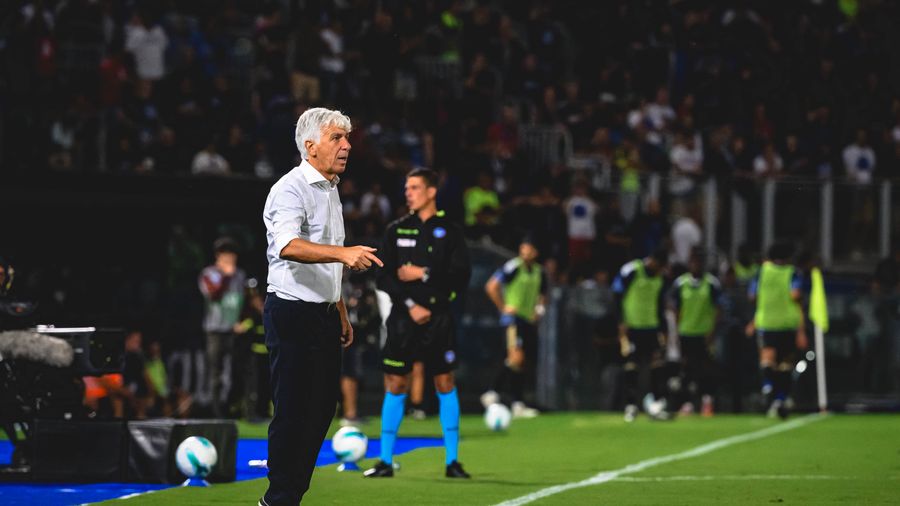
Gian Piero Gasperini has reflected on Roma’s development, Paulo Dybala’s physical condition and Donyell Malen’s extraordinary impact during a wide-ranging interview at the Festival dello Sport in Trento.
The Roma head coach also discussed Gianluca Mancini, Bryan Cristante, the club’s emerging academy players and the financial circumstances behind Alessandro Romano’s move to Cagliari.
Gasperini reveals his first message to Roma
Asked what he remembered about his first training session at Trigoria, Gasperini explained the principle upon which he began building his team.
“That first training session was probably eagerly anticipated by everyone,” he said. “After so many years, I was entering a new environment like Roma. The players arrived extremely well prepared—perhaps they were afraid of my preseason training.
“My only objective was to create something and establish new, different foundations. We never spoke about my previous years. That something new was based on clear playing concepts that were slightly different from what the players were accustomed to.
“The first concept was to go and win the ball rather than wait for the opponent to make a mistake. Everything else started from there.”
Gasperini praises Roma’s “gladiators”
Gasperini described Roma’s defensive unit as a group of “gladiators” and explained how he has attempted to alter Mancini’s behavior on the pitch.
“Hermoso was coming from a negative experience, but he played for many years with Atletico Madrid, a team that plays a certain type of football,” Gasperini said. “He combines the technical quality of Spanish players with important tactical knowledge.
“I found myself with a defence of gladiators, also including Svilar and Ndicka.
“I already knew Mancini because I coached him when he was young at Atalanta. I always wondered why he made himself so unlikeable on the pitch with his provocations. I told him that attitude would also penalize him when it came to the national team.
“That was the first thing I tried to work on with him. He had a fantastic first season with me at Roma and has now returned to the national team.”
Gasperini explains what makes Cristante important
The Roma coach also praised Bryan Cristante’s intelligence, versatility and willingness to place the team’s needs above his own.
“Players are judged from a physical or technical perspective, but for me what I call the control unit is decisive,” he explained. “That means personality, the way you play for the team and the ability to put your teammates’ needs first. The other components are more visible.
“At Atalanta, Gagliardini had been sold to Inter and we brought in Cristante. He had been at Pescara and Benfica but had not managed to establish himself.
“I met his agent, who was a very young Beppe Riso, and got to know Bryan. He could not have lost his technical qualities—he was simply going through a difficult period.
“I spoke with him for quite a while and he convinced me. I was speaking to the right person, someone with strong motivation. He is versatile because he knows how to play football. Many people can play football, but he truly understands how to play it, which is something different.”
Gasperini then confirmed that Cristante will miss Roma’s opening matches after suffering a knee problem.
“He had a minor knee issue,” the coach revealed. “Unfortunately, if you are out for two weeks, you risk missing a few matches. He recovers quickly and has a strong physique, but he will not be available for the first games.”
Gasperini: Dybala is physically improving
Gasperini dismissed the suggestion that Dybala must continually be protected from physical exertion, arguing that regular training has instead helped the Argentine become more resilient.
“He had not started a season like this for years,” Gasperini said. “I was fortunate enough to meet him during my brief experience at Palermo. Many years have passed, but he still has that enthusiasm for playing. You can see that he feels good when he is on the pitch.
“He has suffered from physical fragility over the years, which interrupted his performances. When I arrived at Roma, however, I thought it could be related to his training.
“Many people told me that he had muscles made of silk and needed to be protected, but he was still getting injured. He was genuinely unfortunate with some of those injuries.
“He is training on the pitch and has not missed a minute. Beyond his technical ability, he does not miss a minute in training or matches, and he feels good at the end of games.
“You can improve your endurance through training, and that cannot be viewed as a burden. Last season he suffered a couple of injuries while taking a free kick at home against Torino and a penalty in Milan against AC Milan.
“He still has some difficulty striking the ball as he once did, but he is overcoming it. He had stopped sprinting and was playing almost exclusively through his technique. Now he is beating opponents again and will soon return to striking the ball as he did before.”
Asked whether Dybala ranks among the greatest players he has coached, Gasperini added: “I have coached many, from Jeda at Crotone to Ilicic and Papu Gomez, as well as Milito and Thiago Motta. Dybala is among the best.
“When you watch players like that, you see them do different things with a unique naturalness.”
Gasperini discusses Lulli, Pisilli and Romano
Gasperini credited his background in youth football for helping him recognize the potential of young players such as Emanuele Lulli and Niccolò Pisilli.
“I grew up in a youth academy,” he said. “I started with the Esordienti, then coached every youth level and the Primavera.
“I have always maintained that outlook. Coaching young players teaches you not to view them as finished products to be judged, but to imagine what they could become. For me, that is an important quality.
“Pisilli had already gained some experience when I arrived. Lulli, on the other hand, was not playing very much even with the Primavera.
“I often watched him when young players joined our training sessions. I took him to preseason and played him in the friendly against Borussia Dortmund. I tested him, but ultimately the players tell you what to do. You only need to observe their responses.”
The Roma coach also confirmed that financial considerations contributed to Romano’s transfer to Cagliari.
“He made his debut last year and is a very interesting player,” Gasperini explained. “I was disappointed by what happened to him last week. It seemed as though he was suddenly the player expected to solve the national team’s problems, and then he was excessively criticized after one match.
“Perhaps the adults need to be more careful and remain calmer. Romano was sold to Cagliari because of financial requirements and the need to generate capital gains.
“Other clubs have also sold their best young players to address financial situations. That is not good for Italian football. Clubs should not necessarily have to generate capital gains.
“Young players should be allowed to develop, but when financial needs arise, they are often the first ones sacrificed.”
How Roma unexpectedly signed Malen
Gasperini admitted that Roma had not planned to sign Malen before an unexpected opportunity emerged during the transfer market.
“Sometimes the planets align and things happen that you could never have imagined,” he said. “Malen was a well-known player at Borussia Dortmund and Aston Villa, and we had also faced him in a summer friendly.
“These are the things that happen during the transfer market. You believe you have everything planned, then something unexpected emerges. Sometimes something positive can come from a difficult situation.
“This opportunity arose while we were looking for a striker. Dovbyk had suffered a serious injury and Ferguson was also unavailable. Many names were being considered.
“Then I learned about the possibility of signing Malen, who was going to be sold for tactical reasons. He wanted to play as a centre-forward, and I had always seen those qualities in him.
“He takes three touches: he moves the ball, controls it and shoots. His speed in completing those three actions convinced me that this was his position.
“That is how the situation developed, but nobody imagined that he would produce these numbers.”
Asked whether Malen could reach 30 goals, Gasperini responded: “I always tell him that what he has done is not enough. Someone scored 36. If he reaches 30, I will be happy.”
Gasperini assesses Roma’s gap with Inter
Although Gasperini continues to regard Inter as the strongest team in Italy, he believes Roma demonstrated that they have reduced the distance separating the two sides.
“I always look at our own journey,” he said. “Depending on the moment, the Hannibal in front of you might be Juventus, and during that period you beat Inter.
“Right now, Inter are the best team in Italy. But if you only follow the strongest team, you risk becoming frustrated.
“The objective must be to focus on ourselves. Then you compare the teams, and after our most recent match against Inter, we had the feeling that we had moved closer to them.”
Gasperini also expects Como to remain one of Roma’s direct competitors.
“They are excellent as a team, a project and a club,” he said. “They believe in their style of football and have taken enormous steps, going from the third division to the Champions League.
“You have to admire them. I do not think they are a flash in the pan because they possess resources and ideas. They are a team with whom we will compete.”
Previewing the meeting between the two sides, Gasperini added: “We are two teams that, because of our mentality, want to win matches. That is what we will play for.”
Gasperini moved by Roma supporters
Gasperini described the response of Roma’s supporters as one of the most pleasant surprises of his experience in the capital.
“It has been a wonderful surprise,” he said. “I found extraordinary enthusiasm, an incredible passion for the club’s colors and a beautiful sense of attachment.
“That is also accompanied by the century-long maturity of a club that has experienced everything. I find Roma’s public and supporters genuinely mature.
“They have seen many players and many teams, and they are satisfied with this side. For me, it is a major objective for the fans to recognize themselves in the team. Achieving the maximum would then be extraordinary.
“We are experiencing a wonderful atmosphere and approaching matches with enthusiasm. For now, that is what matters.”
Asked about his objectives, Gasperini offered a simple response: “We want to give the supporters satisfaction. Roma are the most important objective.”
Could Gasperini coach Roma in the new stadium?
Gasperini also expressed his admiration for Roma’s proposed new stadium and jokingly left the door open to one day coaching the team there.
“Let’s hope so,” he said with a laugh. “It seems like an incredible project and an enormous commitment. It has been a long time since a stadium of these dimensions was built in Italy.
“Italian football needs stadiums, and a venue like this in Rome would offer even more to the city and its supporters. It would fill something that is currently missing.
“The Olimpico is wonderful because of its colors. There are always 60,000 people, even when you are not playing a major match, and a stadium like that is beautiful.”
Looking ahead to Roma’s second century, Gasperini concluded: “One hundred years represents an extraordinary wealth of experience and emotion.
“Think about how many people, coaches, players and directors have carried this team forward, and how many supporters have had their weeks shaped by their passion for Roma.
“We must carry that entire history with us because we cannot reject it. Otherwise, there can be no future. I think Roma’s second century will be even more beautiful.”
Source: Festival dello Sport
Leave a Reply